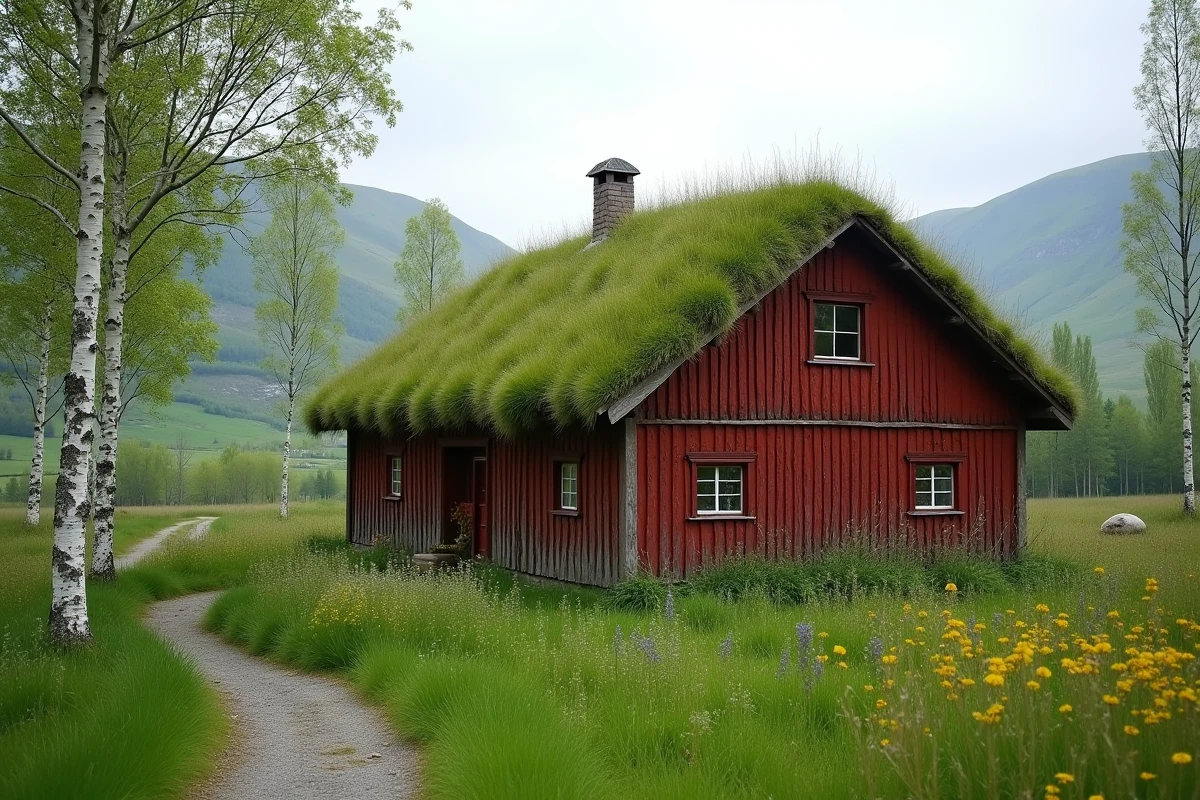
When you step onto a restoration site in the Hemsedal valley or near the Lyngen fjord, the first thing that strikes you is the weight. A Norwegian grass roof, once soaked with water after a downpour, weighs much more than a traditional tile roof. The entire framework must be sized accordingly, and it is this structural constraint that has shaped Scandinavian wooden construction for centuries.
Birch Bark and Crossed Peat: The Layering That Makes It All
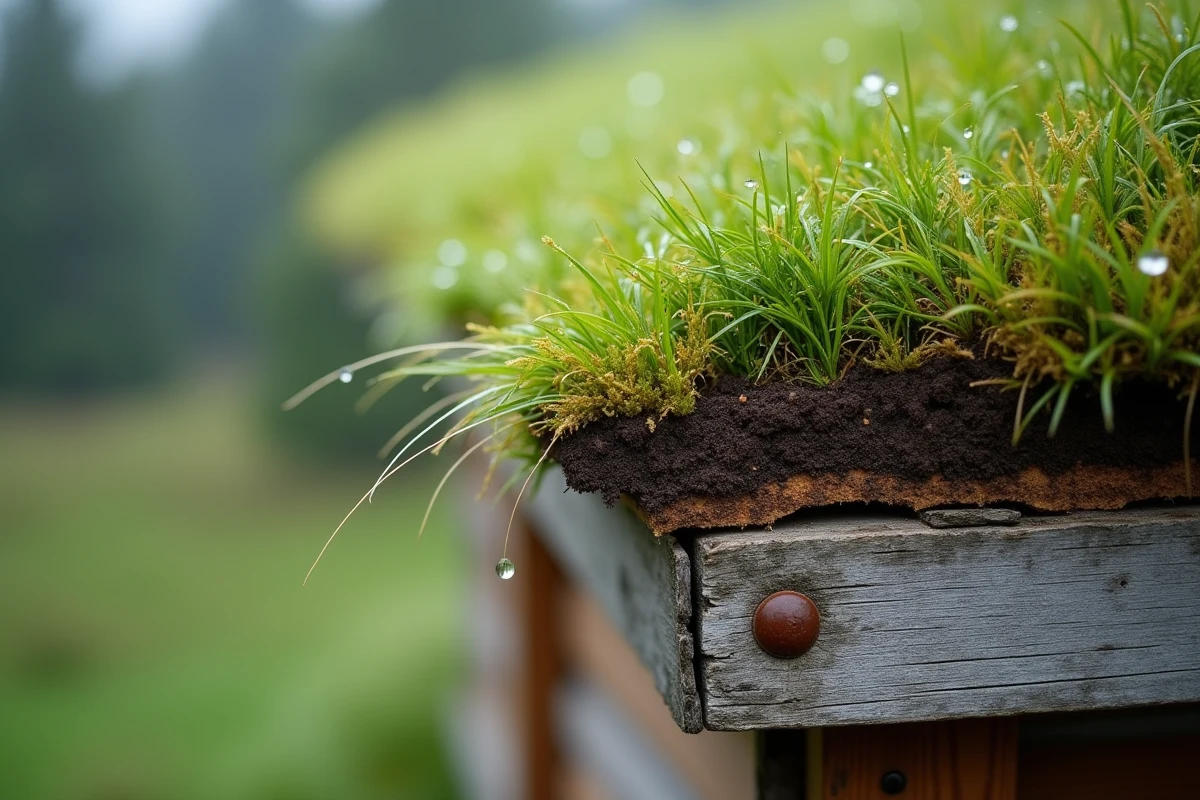
You don’t just put soil on a roof hoping it will hold. The traditional technique relies on a precise layering of several stacked layers. First, a solid pine framework, designed to support the load. Then, a tight boarding onto which a double layer of birch bark is applied, laid in inverted scales to guide water outward.
It is this bark that ensures the actual waterproofing of the roof. The peat, laid on top in two crossed layers (fibers oriented in opposite directions), serves as ballast, insulation, and plant support. The grasses, mosses, and wildflowers that colonize the surface are not planted: they settle naturally.
For those interested in the history of grass roofs in Norway, this layering dates back to the Viking Age and probably to prehistory. In rural areas, it remained the standard until the early 18th century, before tiles became dominant in cities and on manors in the 19th century.
Grass Roofs in Norway: Why Synthetic Membranes Are Problematic
Between the 1970s and 1990s, many homeowners replaced birch bark with synthetic membranes during renovations. On paper, the gain seemed logical: guaranteed waterproofing, quick installation, controlled costs.
In practice, these membranes disrupted the hygrometric functioning of traditional buildings. A classic grass roof breathes. The water vapor produced inside the house slowly passes through the layers of wood and bark, then evaporates through the substrate. With a plastic membrane, this vapor gets trapped, causing condensation, mold in the framework, and accelerated wood degradation.
Since the mid-2010s, several restoration sites (documented notably by the Norsk Folkemuseum in Oslo) have returned to the original complete layering. The goal is not just aesthetic: there is a desire to restore the natural management of water vapor that the old systems mastered without industrial materials.
Checkpoints on a Restoration Site
- Check the condition of the pine framework before any intervention, as wood under synthetic membrane often suffers from invisible surface damage
- Source quality birch bark, harvested at the right time (late spring, when the tree easily releases it), which imposes a constrained work schedule
- Cross the two layers of peat to prevent water from creating preferential paths and carrying away the substrate during heavy rains
- Plan for a retention system at the bottom of the slope (traditionally a board or log) to prevent the gradual sliding of the peat
Scandinavian Green Roofs and Management of Intense Rainfall
With the increase in extreme rainfall events documented in Norwegian cities, the grass roof is regaining unexpected interest. A deep, uncompacted peat substrate acts like a sponge: it absorbs some of the precipitation and mitigates peak runoff that saturates urban drainage systems.
This “sponge roof” principle is now being considered in some Norwegian urban planning for new constructions. It is no longer just about heritage or Scandinavian charm, but about infrastructure for managing rainwater.
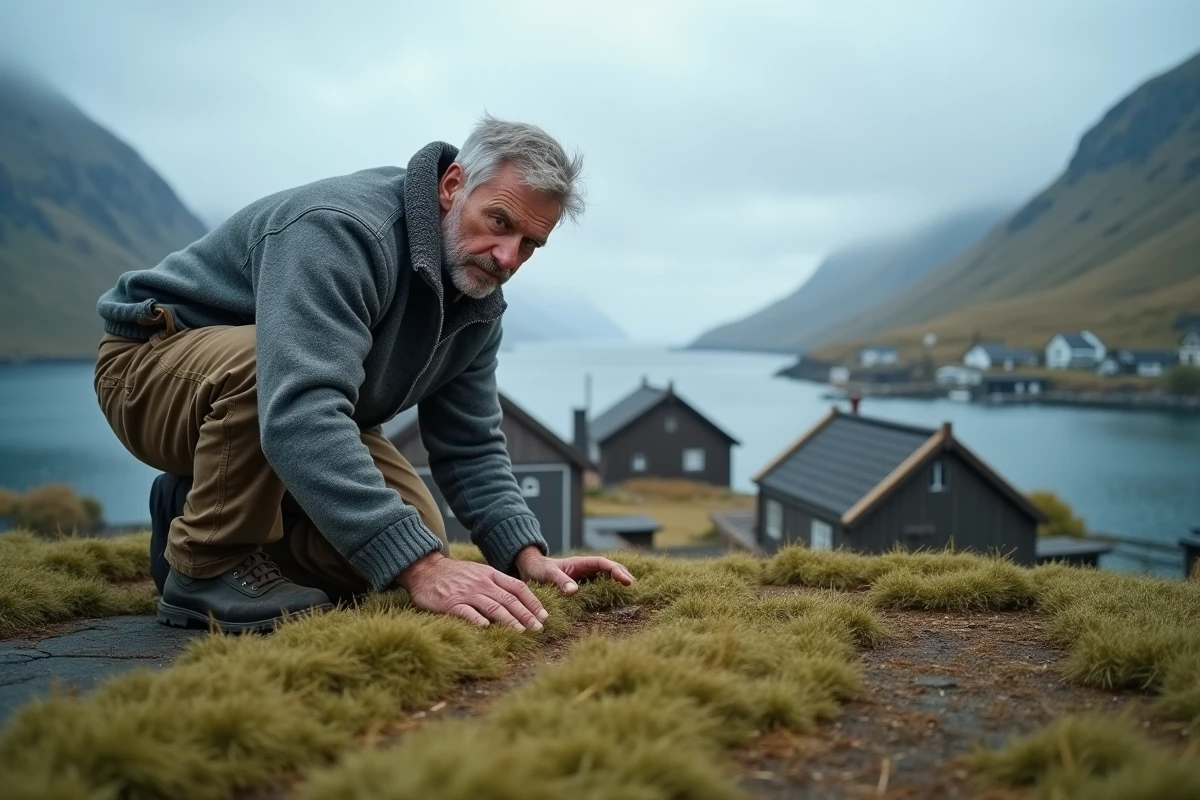
Feedback varies on this point depending on the installations: a restored roof with a thin substrate (a few centimeters) offers limited retention, while a traditional thick roof, with its two crossed layers, can retain a significant amount of water before it starts to run off. The thickness of the substrate directly conditions performance.
Wooden Houses and Grass Roofs: Thermal Insulation Without Electricity
In mountain cabins, shelters, and Norwegian holiday homes, the grass roof remains common. The reason is less about tradition and more about practical reality: peat and vegetation create an effective insulating layer, both summer and winter.
In winter, the mass of soil and the snow cover form a thermal buffer that slows heat loss. In summer, the vegetation absorbs solar radiation instead of reflecting it inward. For a house without electricity or intermittently connected, this passive regulation makes a real difference in daily comfort.
What Distinguishes a Grass Roof from a Modern Green Roof
The green roofs found on contemporary buildings (sedum, mineral substrate, draining membranes) share the basic idea but not the method. A modern green roof uses calibrated industrial materials. The Norwegian grass roof relies on raw local materials (pine, birch bark, peat) assembled without manufactured products.
This distinction has a direct consequence: the maintenance of a traditional roof requires artisanal know-how that few roofers still master. The Norsk Folkemuseum and a few specialized artisans pass on these techniques, but skilled labor remains rare.
- The modern roof uses a lightweight mineral substrate, while the traditional roof uses a heavy organic substrate that requires a reinforced framework
- Birch bark replaces the synthetic membrane and ensures breathable waterproofing
- The vegetation of the traditional roof is not selected: it reflects the local flora, making it a micro-habitat for insects and birds
The Norwegian grass roof is not a frozen postcard object. It is a complete construction system, calibrated for a specific climate, that regains technical relevance in the face of water management and passive insulation challenges. Its survival depends less on the desire to preserve a heritage than on the ability to train artisans capable of correctly laying each layer, from the birch bark to the crossed peat.