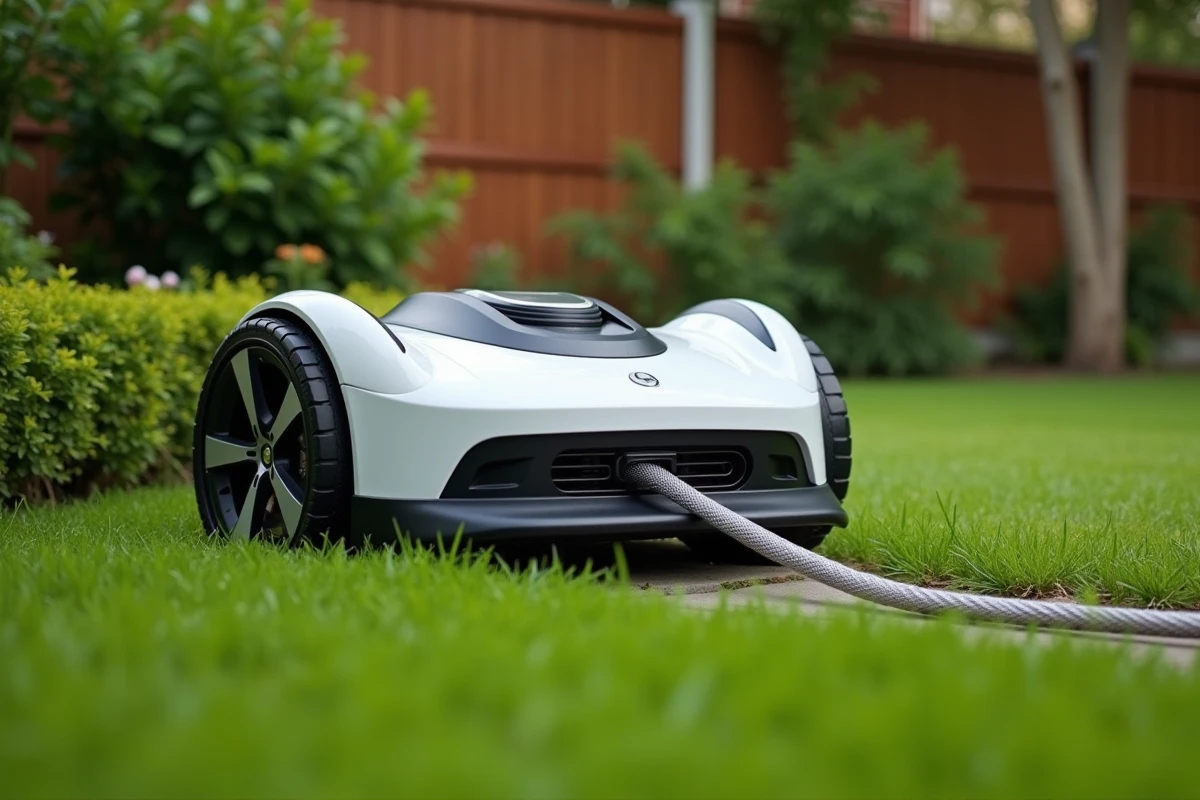
A lawnmower robot left unattended in a garden remains an easy target: lightweight, accessible, and resalable. Protecting it requires combining built-in software barriers with physical measures suited to the terrain. Here are the mechanisms that matter, how they work in reality, and the blind spots to watch out for.
Geofencing and app locking: the game-changing software layer
Most articles on the subject stop at the PIN code and the sound alarm. These two functions are useful, but they are not enough to neutralize a stolen robot. Geofencing provides a higher level of protection.
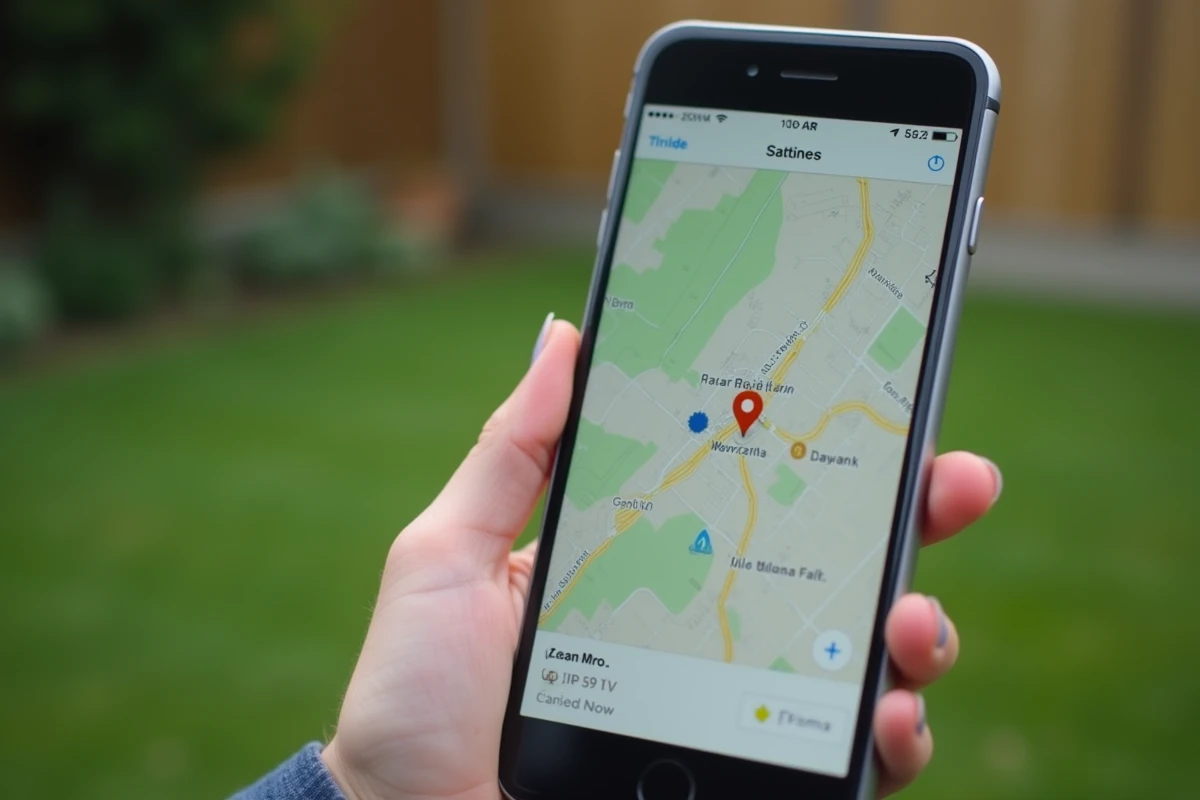
The principle: the manufacturer’s mobile app defines a virtual perimeter around the mowing area. As soon as the robot crosses this boundary, a notification is sent to the owner, and its operation can be restricted or even blocked remotely. Husqvarna, for example, offers a geofencing feature that allows for precise tracking of movements from a smartphone, in addition to the PIN code and the traditional alarm.
The main advantage of geofencing lies in remote blocking. A thief who takes the robot outside the defined area ends up with a useless device, even after a local reset attempt. Combined with the manufacturer account lock, this system makes resale very difficult: the robot remains linked to the original owner’s account in the manufacturer’s database.
Solutions for theft protection and anti-theft for lawnmower robots benefit from being combined to cover both opportunistic theft and organized theft.
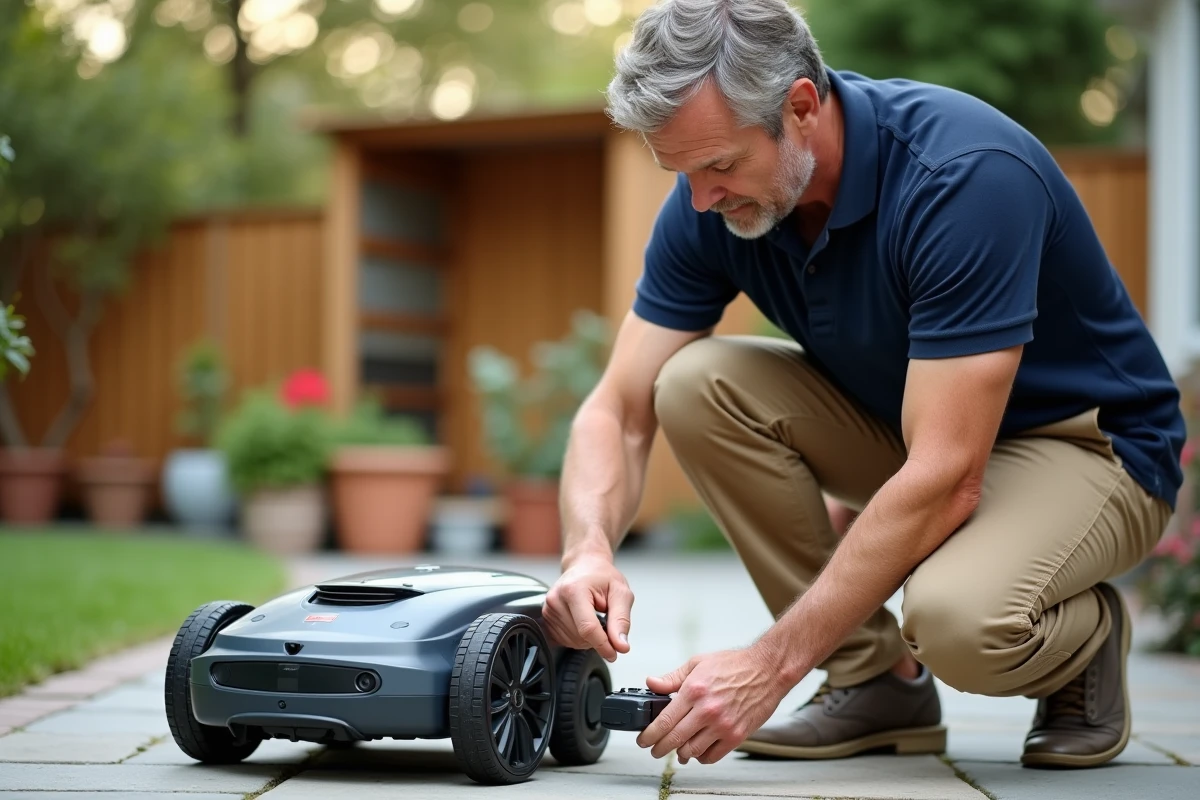
Securing the charging station and physical protection for the lawnmower robot
The charging station is the most underestimated weak point. Securing the robot is pointless if the base itself can be ripped out in seconds.
Securing the base to the ground
Screwing the charging station onto a concrete slab or using metal anchors driven into the ground complicates the theft of the whole unit. A hurried thief who cannot take the base also cannot recharge the stolen robot, which reduces its resale value.
Lockable shelter
A lockable lawnmower robot garage protects against both theft and the elements. For the protection to be real, the shelter must meet a few concrete criteria:
- Rigid material (metal or treated wood), not just a simple plastic shell that can be lifted by hand
- Lock or padlock resistant to tampering, secured to a solid anchoring point
- Dimensions suitable for the robot to enter and exit automatically during its mowing cycles
A locked shelter combined with an anchored base significantly reduces the risk of opportunistic theft. The time required for a break-in increases, and most thefts of this type rely on speed of execution.
Traceability by serial number and manufacturer databases for stolen robots
Several brands have set up product registration databases. When a robot is reported stolen, its serial number is recorded in a manufacturer database. Any attempt to re-register or request after-sales service on this device triggers a report.
This system acts as an economic lock: the stolen robot loses its value in the legitimate second-hand market. Buyers who check the serial number with the manufacturer can identify a stolen device before purchase.
To activate this protection, the robot must be registered on the manufacturer account upon installation, and the serial number should be kept in a separate location (photo of the label, purchase invoice). In case of theft, this information allows for a precise police report and facilitates the work of investigators.
Home insurance and lawnmower robot theft: what insurers require
Coverage for the theft of a lawnmower robot by home insurance depends on specific conditions that many owners discover too late.
Some insurers condition compensation on the activation of anti-theft devices (PIN code, alarm, app locking) or proof of physical measures such as a closed shelter or base anchoring. La Mobilière, for example, specifies that coverage depends on the general conditions and precautionary measures declared at the time of subscription, with particular attention to theft in the garden.
Before installing the robot, the points to check with the insurer are as follows:
- Is the lawnmower robot covered as an item located outside the building?
- What compensation limit applies, and what deductible for theft in the garden?
- Is activating the PIN code and geofencing a condition for coverage?
- Is filing a police report within a specific timeframe required?
Without these prior checks, an owner may find themselves without compensation despite a premium that theoretically covers outdoor furniture. Declaring the robot and its active protections at the time of subscription remains the best guarantee of being covered in case of a claim.
Independent GPS tracker: an additional layer of security to locate the robot
The GPS integrated by the manufacturer depends on the manufacturer’s app. If the thief manages to disable the module or jam the signal, localization becomes impossible. Adding an independent GPS tracker, hidden in the robot’s chassis, provides useful redundancy.
These miniaturized trackers operate on their own SIM card and transmit the position in real-time via a third-party app. The thief who neutralizes the manufacturer’s system does not know that a second device continues to emit. The cost of such a tracker remains modest compared to the price of the robot itself.
The combination of manufacturer geofencing and an independent tracker covers both scenarios: quick theft by an opportunist (stopped by software blocking) and prepared theft by someone who knows the weaknesses of the embedded system (detected by the third-party tracker).
Protecting a lawnmower robot relies on stacking complementary barriers. No single measure is sufficient, but a registered, geofenced, physically anchored robot declared to the insurer with its active protections becomes a far less profitable target than a device simply left in the garden.